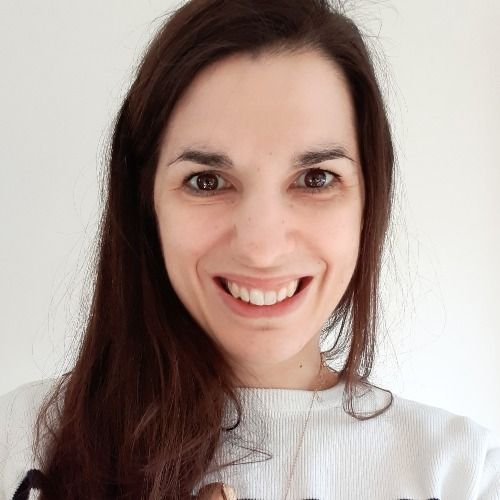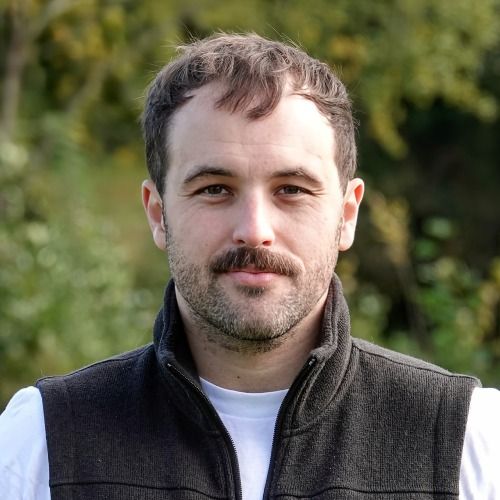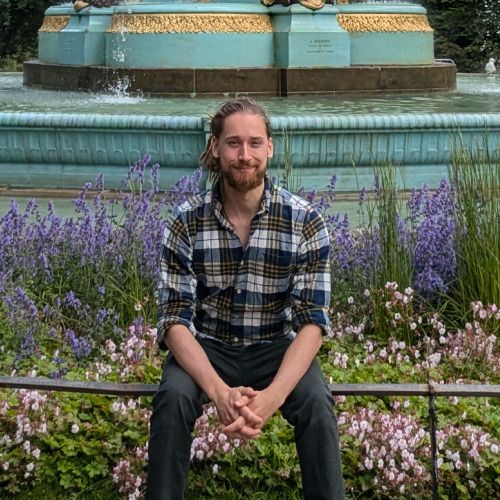

Thulani Rachia & Oli Shorttle in conversation
Each year, we invite the Cavendish Arts Science Fellow to join us for a conversation with one of the scientists whose ideas helped shape their time in Cambridge.
Today’s episode is one of those conversations, and I’m delighted to welcome artist Thulani Rachia and planetary geoscientist Oliver – Oli - Shorttle to the studio.
Thulani is the fifth Cavendish Arts Science Fellow. A South African artist working across moving image, performance, music composition and sculpture, he explores two closely connected ideas: critique and recovery. His work, which has been shown nationally and internationally, questions how communities can reclaim what colonial violence has erased or displaced.
Over the past year, Thulani has immersed himself in conversations with Cambridge scientists though the annual Cavendish Arts Science Fellowship at Girton College. One of the strongest connections to emerge was with Oli, sparked by a deceptively familiar material central to both their work: graphite.
Oli is Professor of Planetary Geoscience, working across the Institute of Astronomy and the Department of Earth Sciences at the University of Cambridge. Combining fieldwork, geochemical analysis and modelling, he investigates the chemical and dynamic processes unfolding within planetary interiors and crusts.
What follows is a conversation that begins with the graphite in a pencil and quickly expands…to darkness and light, lightning and deep time, the origins of life and the histories held within materials. Along the way, Thulani and Oli ask what artists and scientists can reveal to one another when they resist easy answers and follow a shared question… wherever it leads.
Useful Links:
- Explore Thulani's work : obuyile - Thulani Rachia Studio
- If you would like to learn more about Oli's Planetary Chemistry research visit Planetary Chemistry – University of Cambridge | Oliver Shorttle
- Learn more about the Cavendish Arts Science programme and fellowship at Cavendish Arts Science
- Thulani refers to the project: RE Handle with care. Watch the videos: https://vimeo.com/1215845563 and https://vimeo.com/1215854527
Share and join the conversation
- Help us get better by taking our quick survey. Your feedback will help us understand how we can improve in the future. Thank you!
- If you like this episode don’t forget to rate it and leave a review on your favourite podcast app. It really helps others to find us.
- Any comment about the podcast or question you would like to ask our physicists, email us at podcast@phy.cam.ac.uk or join the conversation on Twitter using the hashtag #PeopleDoingPhysics.
Episode credits
Hosts: Vanessa Bismuth
Recording and editing: Chris Brock
This podcast uses the following third-party services for analysis:
OP3 - https://op3.dev/privacy
Transcript
You could hold a rock the size of your hand, and it represents millions of years of slow accumulation of sediments.
And lightning itself actually has a really unique fingerprint in the rock record.
When lightning hits a sediment, it fuses the grains together and produces something called a fulgurite.
So there's a really unique type of deposit which actually represents the flash of lightning hitting the ground itself.
Vanessa Bismuth:Welcome to People Doing Physics podcast that explores the personal side of physics at the Cavendish Laboratory, University of Cambridge.
I'm your host, Vanessa Bismuth, communications manager at the Cavendish.
Each year we invite the Cavendish Art Science Fellow to join us for a conversation with one of the scientists whose ideas helped shape their time in Cambridge.
Today's episode is one of those conversations, and I'm delighted to welcome artist Thulani Rashia and planetary geoscientist Oliver to the studio.
Thulani is the fifth Cavendish Art Science Fellow.
A South African artist working across moving image, performance, music composition and sculpture.
He explores two closely connected critic and recovery.
His work, which has been shown nationally and internationally, questions how communities can reclaim what colonial violence has erased or displaced.
Over the past year, Thulani has immersed himself in conversations with Cambridge scientists through the annual Cavendish Art Science Fellowship at Girton.
One of the strongest connections to emerge was with Olli, sparked by a deceptively familiar material central to both their graphite.
Oli is professor of Planetary geoscience working across the Institute of Astronomy and the Department of Earth Sciences.
Combining fieldwork, geomechemical analysis and modeling, he investigates the chemical and dynamic processes unfolding within planetary interiors and crusts.
What follows is a conversation that begins with the graphite in a pencil and quickly expands to darkness and light, deep time and lightning, the origins of life, and the histories held within materials along the way.
Thulani and Oli ask what artists and scientists can reveal to one another when they resist easy answers and follow a shared question wherever it leads.
Stay with us.
So hi to Lani.
Thulani Rachia:Hi, Vanessa.
Vanessa Bismuth:Hi, Oli.
Oli Shorttle:Hi.
Vanessa Bismuth:So we'll start with a like a simple question.
Take us to the beginning.
How did the two of you first come to each other's orbit?
Whoever wants to start, I can start.
Thulani Rachia:I had first contact with Paul Rimmer, who's also a naturophysicist, and he was on the interview panel for this opportunity.
And so in that interaction we'd had, he'd spoken a bit about his work, which really interested me because of my research I was doing into graphite for this film that I'd been developing.
And so he was one of the first, people that I contacted, and then he put me in touch with Ollie because of the work that they'd been doing, the research that they'd been doing.
Sorry.
Yeah, so that's how we came into contact.
Vanessa Bismuth:So you just talked about that opportunity.
So tell us about the Cavendish Art Science Fellowship.
What brought you to it and what did you hope to explore during your time in Cambridge?
Thulani Rachia:So.
So it's essentially an opportunity for an arts practitioner to come into the Cavendish sort of environment and to be immersed here and to have conversations with different physicists and the work and research that they're busy with.
And, yeah, I guess the idea is to basically start focusing in.
On an area of research of interest and sort of make or develop a proposal of art from there.
And so it's basically just to start thinking about how your process and art making can be influenced from what you've encountered in this environment and the conversations you've had.
I had been working with a geologist in Edinburgh for this film that was centered around graphite over the last sort of two years.
And so when this opportunity came up, I just felt like it would be great to, yeah, try and dive deeper into that research and expand on it as well.
So that was the main reason why I'd applied.
Vanessa Bismuth:And, Ollie, what did you expect when the artist Tula Nikhom came to you with questions around graphite?
Were you expecting anything?
How did you approach that?
Oli Shorttle:Yeah, I suppose I expected we'd very quickly find the boundaries of my knowledge and expertise, which is as much a hope as anything else, because then it's a fantastic opportunity for me to learn and also think to make more new connections between different bits of my research.
So, like Jelani mentioned, Paul and I had been working on graphite in the context of thinking about the origin of life and how chemistry on young planetary surfaces could go from being inorganic chemistry all the way through to organic chemistry and maybe eventually biochemistry.
And we'd recently thought that graphite could play an important, important role in that.
But graphite is something I also learned about as a.
As a geologist during my training and now features in this new way in my current research, which straddles astronomy, earth sciences and planetary science.
And graphites popped up again and again across those areas.
So, yeah, I was excited to have a conversation that really thought broadly about graphite, the human connections as well as the planetary Earth science connections as well.
Vanessa Bismuth:Well, so this is actually the fascinating point that I really want to dive into.
So this conversation began with graphite as its center, and that's a material that many of us associate with a pencil.
Can you tell us, Sulanyu, a bit more about how it found its way into your work?
Thulani Rachia:Yeah, so I've been currently, and I'm at the moment developing a film project which is centered around graphite.
And one of the sort of aspects that it looks at is this myth around the discovery of graphite in the UK in the 16th century.
No, 17th century.
And basically at the Smith goes that there was this massive thunderstorm in this area village called Seatheswaite in England in the Lake District, and it was historically a sheeping village.
And these sheep farmers went out onto their farm the following day and they'd seen that there'd been these trees that were uprooted and on further investigation saw that there was this black substance in the roots of the trees.
Yeah, they touched it and it sort of left these marks in their hands.
And that was said to be the sort of discovery of graphite in the area.
And so I was primarily interested to, you know, have conversations with Ollie because, you know, there was the aspect of lightning as well as graphite that I knew that, yeah, he had like, specialism in.
And, yeah, similar to Paul, you know, these were both these sort of materials and phenomena that I was really interested in researching further into.
And so that was the sort of.
Yeah, primary reason why I particularly wanted to speak to Ollie.
So, yeah, that's kind of brought us together in that way.
Vanessa Bismuth:So what is interesting about graphite from.
As a scientist and what might it have to do with the origins of life?
Tell us about that.
Oli Shorttle:Yeah, so most of the graphite on Earth is going to be itself the product of biological activity.
It'll be the result of organic matter that was once growing, living at the surface of the Earth, having fallen to the bottom of some lake or some ocean and ultimately finding itself in the rock record and under pressure and temperature, being converted into graphite, so transformed from its original biological state into this inorganic substance that Tilani was describing.
But that's graphite emerging because of life.
We got excited about graphite as actually being able to clean up the chemistry that's emerging from things like maybe volcanic vents on the.
On the early Earth.
And, you know, one of the big challenges in origin of life chemistry, as much as it's producing any one molecule, it's.
It's producing just that molecule as opposed to a load of others.
So you want chemistry that's sort of selective and focused on producing just the things you need and not a load of other stuff.
And that's true for Volcanic gases, which often have lots of chemicals in them, and some of them are using up atoms, making sort of useless chemicals that you'd much rather produce the chemicals that are really useful for the chemistry you want to see happen.
And in this case, we're thinking about the chemistry that might have occurred on the early Earth to ultimately give rise to life.
And so it turns out we.
We did some calculations and it looked like graphite was actually going to be really useful for turning some messy volcanic gas chemistry into sort of clean products, which, if fed to the surface of the early Earth by hydrothermal systems or smoking vents like that, would actually be great feedstocks and great building blocks to begin origin of life chemistry.
So that does create a sort of bit of a chicken and egg problem.
You want the graphite to clean up the chemistry to make the life.
Yet most graphite today is the product of biological activity.
We had some thoughts about how you could get that graphite without life involved, but that's sort of the way it features in our work presently.
Vanessa Bismuth:And when you hear this kind of things, Tolani, what does a.
In.
What does that suggest to you or where does that take you in terms of your own views on your word, like the graphite in your work?
Thulani Rachia:Yeah, well, I mean, the.
The film that I'm developing, which is not necessarily a part of, because they're basically multiple areas of research that I've been looking at while I've been here.
So this film concerned with graphite has not been my main focus, but essentially the interest for me in the film is kind of looking at this material and how it's been sort of used in these different contexts in the Lake District, in C Suite and also in Johannesburg.
And so it's looking at, I guess, the social, historical, political and industrial histories of these places and how they affect the sort of contemporary moment.
And so, yeah, it really interested me then to hear about how within the work that Ollie and Paul were doing, they were looking at.
Yeah, the sort of origins, you know, or the sort of origin story, which was really interesting to me because I think in.
Yeah, in a lot of my work, I think about time and also kind of use time as material.
So it is really interesting to think about these sort of differing timescales.
Yeah, so that was really of main interest to me, this sort of relationship that this material has to time.
Oli Shorttle:Yeah.
And I.
And, yeah, time is.
Yeah, time is exactly what's needed to sort of embed graphite in the rock record.
And potentially, you know, that's a process of Converting organic matter into graphite, which itself may take millions of years, and then it lays underground undiscovered or not exposed to the surface for many tens of millions of years more.
Yet the actual life that initially grew and died, providing the sort of raw materials to eventually become graphite, may represent itself, you know, a year or less.
So, yeah, time is sort of really elastic in.
In this material, so lots of different timescales reflected.
Reflected in it, which I find really interesting.
And you mentioned lightning as well.
You sort of.
It's really sort of.
Yeah.
Something really sort of interesting about how lightning ended up revealing it.
Sort of something which is almost defined by being know.
Almost instantaneously we complete the other end of the timescale spectrum.
Yeah.
Revealing this ancient material as I have.
Vanessa Bismuth:Plenty of questions around lightning and those.
The sense of time.
But I just wanted to.
To go back to the graphite just a little bit more before we move on the origin.
Like the original element is in graphite is carbon, isn't it?
Yes.
And you talked beautifully in the prep conversation to learn about darkness and mines, carbon and the underbelly of history.
Tell us more about that.
How are darkness and light working visually for you?
Thulani Rachia:Yeah, I guess in this film that I'd been developing initially, my request when I contacted Ollie, because I'd spoken to Paul about the film and sort of really thinking about the aesthetic of the film.
And previously with this.
His name is Tom Shalott, who's a.
A geologist.
Geologist in Edinburgh.
And in my conversations with him, he had actually brought up the study and sent it to me about carbon being involved in sort of first forms of life.
And it wasn't graphite that he'd spoken about, it was more carbon.
And so, yeah, when Paul had sort of mentioned the work that he and Ollie were doing, it was really, you know, wanting to have more conversations about that.
But essentially what I'd done when I'd been developing this work is that I'd visited the mines in Seatheswaite in sort of Borrowdale, which is where graphite was mined after what it was sort of initially discovered.
And it led to this big sort of industrial boom.
And so.
So I went there and I did quite a lot of filming in these mines that are sort of decommissioned now.
And it was really fascinating because, you know, when you're in there, because at that time there was no electricity, it was candlelights that they were using to see what they were doing.
And it was really just fascinating because I'd never experienced complete darkness in that way in these minds There is literally like no light.
You can't see your hand in front of you.
And, you know, there was a real loss of sort of.
Yeah.
Sense of orientation.
So, yeah, that really got me thinking about this material.
And also in sort of, you know, carbon in the form of graphite is almost like anti light in some ways.
And so, yeah, I had been sent these drawings essentially of these cross sections of graphite, these sort of diagrams, and became really interested in those.
And so I was curious to try and take my own cross sections.
And that was actually one of the reasons why I'd gotten in touch with Ollie so that I can try and do that.
Because I was really interested in trying to develop.
Develop, yeah, some sort of aesthetic for this film.
And I was really curious about how this material interacted with.
With light.
Because also when you're in the mines, because we all had sort of head torches and the way that you could see that there was actually graphite, was that it.
You know, it was this metallic sort of.
Yeah, it was metallic.
Essentially this kind of reflective quality to it amongst the sort of other rock.
And so that was really interesting.
But, yeah, so I just became really interested in this sort of materiality and exploring that further.
And so over time and more research started developing this, I guess, visual metaphor of dark and light sort of being submerged and thinking about, yeah, the stories that I'm essentially trying to excavate from this mine and the stories that this material holds.
And, yeah, it felt like this sort of exploration of this sort of.
Yeah.
Underbelly and trying to sort of expose these.
These histories and connect them to sort of contemporary moment as well.
Yeah.
Don't remember what the initial question.
Vanessa Bismuth:No, no, but that was it.
But then I think only you also meant at some point in our conversations, we mentioned that diamond was also made of carbon, which is the total opposite of graphite.
Right.
It's gray and dark or it's shiny and light.
So there's lovely scientific twist here, I think.
Oli Shorttle:Yes.
I mean, this is one of the examples of, yeah, the really kind of fun connections that you make having these types of conversations.
So I really like.
Yeah, the link with light and graphite and how actually it sort of.
You can trace a story all the way through with that.
So, you know, the life that would originally have been at Earth's surface to provide the organic matter to ultimately die and accumulate and get turned into graphite in the rock record would have been part of.
Powered by light, by the sun's light.
The sun's light powers essentially all life on earth.
So the beginning of any of this is with light creating the means for graphite or the building blocks of graphite for carbon rich organic matter to accumulate.
And then in the rock record, it's turned into this substance which almost refutes light.
Like you said, it's got a metallic lustre.
It's dark, it doesn't let light through it.
And the way I was trained to identify graphite in these thin cut sections of rock, when you try and pass light through it is.
Graphite is the stuff which does not permit light to pass through.
It will be the.
The absence of light in your field of view will be the stuff that's graphite.
And all the crystals will be letting some amount of light through.
And so it's really interesting then that subject to e. Even more pressure, the material transforms once again into diamonds suddenly, which obviously is.
Is prized aesthetically because precisely because of its interaction with light and, you know, all the reflections that you get off the facets of those, those crystals.
So it's sort of really.
It's got this sort of really mutable relationship with light, but it's a relationship which is there from the very beginning because of what needed to happen for the materials to accumulate to get the graphite in the first place.
Vanessa Bismuth:So how come the same element can become something so drastically different?
Is that the pressure that you mentioned?
Oli Shorttle:Yeah, exactly.
Yeah.
So it reorganizes itself.
So the way the carbon atoms are organized in space, in the case of graphite, I suppose it's use as a material that we can mark surfaces with is because it's so willing to shed layers of itself.
So, you know, when we're writing with our pencils on paper, you know, layers of the graphite are being shed onto the page and sort of sticking to it, essentially.
Whereas, yeah, it's not only the relationship with life light that's transformed, but, you know, the material properties are going from graphite to diamond as well.
A diamond is almost, you know, is the.
It's the material with the defining opposite properties.
I mean, it is harder than everything else.
You know, it will, it will be the material if you want to grind something down.
If you want to grind a rock down, you'll do it using bits of diamond to break up and polish and grind down a rock.
So, you know, you go, it's exactly the same.
Carbon atoms arranged differently go from being extremely soft so that we can write on paper with it, to a substance which, aside from its aesthetics, is valued because it is so hard and you can use it to cut and grind other materials.
Thulani Rachia:Yeah, it's really interesting because even sort of in the process of figuring out the sort of materiality of graphite and sort of investigating how I was going to sort of incorporate the actual material in the film, I had some samples that were gifted to me from the mine in Borrowdale.
And this is from the sort of spoil heaps.
And so worked with some of the geologists that I was working with and they sort of milled it down into this sort of more sort of.
Yeah.
Granular sort of powder form.
But just hearing you speak about diamonds and diamonds being used and.
And the machines and just thinking about.
Yeah.
That this diamond or this machinery that has potentially diamonds in it is sort of grinding down.
Yeah.
Graphite and they're being made of the same thing is also just an interesting relationship.
Vanessa Bismuth:Yeah, I find it fascinating.
It's just the.
There's something very rich in the fact that one element can become something completely different and other things, like living things and ancient rocks.
And we could go on with that subject, probably.
But let's move on to you and go back to storms and thunderstorms and the idea of the time and so storms keep appearing in your work.
Thulani, where does that come from?
Thulani Rachia:Yes, I. I don't quite know what the source of it is, but it is something that just keeps coming up in my work and so I kind of am just going with it.
Yeah.
I'm from South Africa, so Benjanis book in particular.
So I have, you know, loads of memories growing up in the summertime and having these.
Yeah.
Incredible sort of thunderstorms, you know, that would really light up the sort of landscape in the summer.
A lot of our landscape is sort of like a.
What's the color?
Like a. I guess like beige.
Like brownie.
Beige color.
The long grass and the landscape.
And when you have a thunderstorm, it just becomes illuminated, you know.
Yeah.
And I have a lot of these sort of images of, you know, of that.
Of that time, I guess.
More recently, thunderstorms and lightning have, I guess, intervened in work that I've been doing.
I did an exhibition a few years ago at House for an Art Lover, which is a studio space, studio gallery space in Glasgow.
And it sits on Bella Houston Park.
And historically, in:And so right now there's a museum that basically commemorates the Great British Exhibition, which was a kind of theme park site that you could visit where you would see all the sort of colonial sort of industries and yeah, so this museum basically houses Memorilia from this great British exhibition.
And so our installation was housed in this museum.
Me and a Zimbabwean artist named Sikaima Chache were invited to exhibit our work there as part of Glasgow International.
And I found the site and its materials quite violent in terms of there being no sort of critical engagement from the museum.
And so I created an open letter which basically, yeah, spoke to that, calling in the, you know, and the festival organizers about this and talking to the fact that, yeah, talking to my experience of being in the space and interacting with these materials.
And so I projected them onto this vitrine in the museum space which held some of this memorabilia.
And it was this rolling open letter just of text, which kind of the text rolled over these objects and also illuminated them as well.
And then, yeah, the day before we de.
Installed the show, there was this massive thunderstorm and following that, in the morning we went to go and de.
Install the work and the vitrine had been flooded.
A lot of the sort of pamphlets, you know, tea tiles, tickets from this great exhibition were drenched in water.
And me and my collaborator just, yeah, we were just so surprised obviously by what had happened.
But we'd also seen this as an intervention from Mother Nature into the space because the space hasn't opened since.
And we'd created a video work basically, which also documented this flooding, essentially.
And so since then I've been really, yeah, thinking a lot about sort of thunderstorms, lightning in particular, as this.
Yeah, this intervention.
Yeah.
Vanessa Bismuth:Ollie, what's.
Is there any thunderstorms in space on planets, on other planets?
What does lightning do to.
Oli Shorttle:Yeah, that's planet's chemistry.
Yeah, it's interesting.
We've actually, yeah, one thing we've been investigating is whether there's lightning on Venus and in fact this has been a long standing question is whether whether there's lightning in Venus and.
And sort of the way this connects actually back to this question of.
Of life and origin of life is, you know, a lot of.
A lot of what we're trying to understand with.
With this question of how a planet could undergo some process which results in biology suddenly appearing, presumably progressively appearing out of inorganic chemistry is how do you make the molecules that seem useful for starting off the chemical process of life or the chemistry of pre life, and those are not molecules that are found abundantly at Earth's surface to today.
They're not produced abundantly at Earth's surface today.
So there must have been something particular about the conditions of.
Of the early Earth that allowed them to be produced and then accumulate in sufficient quantities that they.
They could actually drive chemistry.
And we've talked a little bit about volcanic gases and them interacting with graphite and maybe producing some of these molecules like hydrogen cyanide is one that receives a lot of attention.
Another process that's of interest in this same area is lightning, because it's so energetic that it can break up the molecules you've got to begin with.
So things like the nitrogen in the atmosphere, which is largely present as N2, so two nitrogen atoms sort of stuck together, but they're really strongly bonded, those two nitrogen atoms.
So you need a lot of energy to split that.
Lightning is sufficiently energetic.
It can be.
Break the nitrogen bond in N2 in nitrogen gas and give you ultimately produce some hydrogen cyanide.
And so on Venus, we've seen there's some evidence in the chemistry of Venus's atmosphere that maybe lightning is taking place.
We see some molecules that sort of shouldn't be there if the atmosphere was just left to itself without any energetic process taking place.
So there's been some suspicion that maybe flashes of lightning have been seen, but nothing 100% convincing.
Another way at the problem is to look for this atmospheric chemistry that's a sort of fingerprint itself of energetic processes like lightning taking place.
And whereas on Venus, we maybe wouldn't suspect that it's got the right conditions for that chemistry to give rise to life.
It's a planet whose surface is over 400 degrees, see 100 times more massive atmosphere than Earth's.
It's nonetheless really interesting to see, you know, the same processes or find evidence for the same processes happening commonly amongst planets.
And lightning is also thought to take place in the atmospheres of the giant planets in the solar system as well.
So it seems to be a really sort of universal phenomenon in planetary atmospheres.
And something I sort of reflected on in our conversation as well is on the.
Yeah, is on.
Is on time and how, you know, different geological events are sort of written into the rock record in different ways.
So, you know, our ability to reconstruct Earth's past essentially entirely comes from looking at, you know, the stacked layers of rocks that we can access, you know, around.
Around the planet.
And they sort of have very.
They have a sort of very elastic relationship with time there.
Some bits, some bits of rock are recording, you know, almost those instantaneous events.
They're recording a single storm.
And so the rock itself represents a storm deposit, you know, so it could represent really just 12 hours of tumultuous churning of wind waves and an ocean at Earth's surface is written into the rock record.
And at other times, you could hold a rock the size of your hand and it represents millions of years of accumulation, slow accumulation of sediments.
And lightning itself actually has a really unique fingerprint in the rock record.
When lightning hits a sediment, it fuses the grains together and produces something called a fulgurite.
So there's a really unique type of deposit which actually represents the flash of lightning hitting the ground itself.
So, yes, you get this in the rock record and trying to reconstruct Earth's past, you get these glimpses of, you know, an hour, a second or a day, and then you're back to, you know, long stretches of time that essentially are completely unrecorded.
So time is sort of really kind of gappy, essentially, but also really variable in how it's recorded.
So something sort of interesting there as well.
Vanessa Bismuth:Sorry.
No, you go ahead.
Thulani Rachia:I was going to say it's really interesting just hearing you speak about fulgurites, because in another project I was doing where I was working with sort of glass and essentially also linked to sort of thunderstorms connecting sort of the material of glass or like.
Yeah, quartz essentially to thunderstorms.
I was really interested in sort of natural forming glass, Just these fulgurite that you speak of and these structures that they.
Yeah, that they form in the sand.
And so I was really wanting to create these sort of glass instruments that have these acoustic qualities inspired by sort of fulgurites.
And was meeting with Jim Woodhouse and he's a material engineer, an acoustic engineer who also makes.
Vanessa Bismuth:Yeah.
Thulani Rachia:Instruments.
And so we'd had a conversation basically around that.
But yeah, it's interesting this sort of fulgurites coming up.
Oli Shorttle:And that's really cool, given the, you know, the other aspect of.
Of lightning is the thundercloud.
Right.
Yeah.
So they've got this both kind of as an audio visual phenomenon.
So it's really wonderful that.
Yeah, you could kind of reconstruct a sort of audio component.
Vanessa Bismuth:I was about coming.
I was actually coming back to that and the thunderclap and the time in between the sound and the light.
And you said to Lani before that thunderstorm changing your experience of our experience of time, you know, the rumble before you see anything in the moment of the storm, the sense of before and after.
Do you want to tell me a bit more about that?
Thulani Rachia:Yeah, I guess that's.
That's kind of been.
That's where I've come to now in terms of all the conversations and observations that I've.
I've made during my time here and sort of starting to, I guess, center on, yeah, thunderstorms and lightning and.
Yeah.
My interest has been how they really change our experience of time.
And it's.
Yeah, it's something that I've been thinking about lots through a lot of the conversations I've been having.
Another conversation I'd had was with a neuroscientist named.
It's okay, Andres Cornelis Johnson.
So bad with names.
Vanessa Bismuth:Sorry.
Thulani Rachia:And he is a neuroscientist that looks at and researches into consciousness.
And so in a lot of his work, he's basically.
He does these, yeah, mappings of the brain and sort of electrical activity and.
Yeah.
Connects that to.
Oli Shorttle:Yeah.
Thulani Rachia:His research and consciousness.
And in our conversations, I became really interested because.
Yeah, thinking about lightning.
Vanessa Bismuth:Yeah.
Thulani Rachia:And the experience of a storm, I was really thinking about this experience of awe that I feel a lot of people experience.
And in a lot of the conversations I was having at Girton is asking people about their experience of or like, war.
What is that for you?
What would you identify that as?
How would you explain that?
What happens to you?
And so, yeah, I was just thinking about these in connection with time as well, because I think when we experience a thunderstorm, it almost becomes this sort of elastic experience.
It can feel very short, but also very long.
And I guess more in terms of neuroscience, it has to do with the fact that we actually don't experience lightning or thunderstorms as they are.
We sort of interpret them because we don't really have the, I guess, ability to experience them the way that they happen.
And so they become this almost sort of dramatized experience.
And I became really interested in that.
And so that's kind of been the main focus of the work and where my, I guess, artistic inquiry has sort of led me.
Oli Shorttle:What do you think the relationship between awe and fear is like?
Do you think you need fear for awe?
Or is awe what you can feel when you're not too afraid?
Thulani Rachia:Yeah, it's so interesting.
I think fear is involved in awe.
I think that there's something about the fact that.
Yeah, I think with an awesome experience, I think there is fear involved.
And I think it has to do with the sort of overwhelming feeling, which I don't quite.
Can't really quite identify, but it has to do.
Yeah, Possibly the scale of the thing.
Yeah, even.
And thinking about the sort of experience of the sublime as well, I feel like there's, you know, if you're on top of A massive cliff.
There is also fear involved there.
You know, thunderstorm.
There is fear involved there.
Yeah.
Something about the sort of scale of the thing and almost like a humbling experience as well.
I think there's an experience of you being aware of your.
Yeah.
Humaness.
And how spiritual small you are in comparison to these things.
Oli Shorttle:Yeah, yeah.
I think scale.
Yeah.
I really like how it reveals.
Like, the thunderstorms reveal spatial scale.
You know, the time.
The time delay is obviously rooted in a.
In a spatial separation between us and the event which, you know, sort of drags us out of a world which is otherwise maybe, you know, controlled you.
It's a world of human architecture and often human scales.
And suddenly there's this thing happening which you can easily sort of tell is happening 6km away or whatever it is.
And it's clearly just.
It's bigger than us.
It's out of our control.
Thulani Rachia:And that's been my main interest with thunderstorms, essentially, because, as you say, these sort of human constructs of time, it really interrupts sort of linear.
Linear time, you know, in these.
Yeah.
These ways that we're so used to experiencing time.
And, you know, in many cultures around the world, there is sort of an opportunity taken when there's a thunderstorm to stop and sort of reset or reflect.
But, yeah, I think in the west, there is this kind of like.
There's that moment that I'm actually not connected to.
It's kind of nothing to do with me.
It's the weather.
It's this thing that's far away.
And so, yeah, I've been really interested in how these moments, like, force us to stop in some way.
Yeah.
Oli Shorttle:Do you think there's something.
An interesting relationship in time and sort of artistic medium you're using as well?
I'm thinking especially of film, which I suppose ultimately is a series of static images that have gaps in a way.
A film is more gaps than it is anything else.
It's just an instant and then some gaps, some gap of milliseconds or whatever, then the next instant.
So in a way, there's sort of a connection there with how I thought about.
The rock record is a series of snapshots which we sort of, as humans, we turn into a contin.
A continuity, you know, a narrative continuity.
Yeah.
And, you know, a narrative continuity of Earth history that we tell and we teach, we try and understand.
But in a way, you know, I suppose a film is doing something similar.
It's sort of a trick where.
I mean.
I don't mean that a Bad way.
But, you know, it's where we sort of are predisposed to turn these.
These static images into a continuity which.
Like, a bit like you said about the thunderstorm, it's how we experience it, but it's not the reality of it.
Thulani Rachia:Yeah, absolutely.
And I think also, you know, as you say, there's almost like a narrative that we built, you know, in film, but also in these moments of a thunderstorm, there is a clear sort of before, during the storm and after this kind of.
Yeah, the structure, you know, that we used to tell stories.
And I also find that really, really interesting.
But, yeah, I'm really interested in this moment of.
Of after, what that can signify, you know, because I think there is an opportunity there and blinks to time, like our experience of time, if we really think about.
Yeah.
What is possible when we.
Yeah.
When we.
Vanessa Bismuth:When.
Thulani Rachia:And we stop.
When we stop with this phenomenon.
And.
Yeah, that's what I need to finish some other time maybe, but I do.
Oli Shorttle:This is a bit of a silly connection, but.
Yeah, going to the cinema to watch a film, sort of.
It's like a giant cave, right.
I mean, it's massive light source.
Massive light source in this giant cave.
It's dark, the lights turned on.
You experience a thing.
And often if you've gone in sort of early or late afternoon, you'll come out into now darkness, like, and sort of the world sort of changed about you as you've been cocooned experiencing this film and you're back in now to a different.
A different place.
You know, you've experienced this new narrative, so you're sort of different in a way.
But then I always have this moment of disconnect in stepping back out either into a city which is still sunny and I've been in this cave, or, you know, it's now night.
Vanessa Bismuth:Yeah.
I want to talk about the process a little bit because it sounds, from what you've mentioned already, to learn that you've had a lot of conversations, but, like one jumping from one to another and leading you to other things.
So I understand that you came in with, like, quite an open mind and not really any strict line of inquiries you wanted to follow.
Tell it.
Tell me, tell me more about.
Yeah.
How you approach that.
And.
Thulani Rachia:Yeah, I guess most.
Yeah, most of the previous fellows have had a really specific area of inquiry.
I guess my approach or strategy was to not have that.
I. I just think it's an incredible opportunity to have this access to so many incredible, you know, people doing all sorts of interesting research and So I want to have as much interaction within the sort of department and outside of it as well, and just allow the conversations to sort of guide me.
And.
Yeah, so that's.
That's essentially been my approach.
And that approach has allowed me to have so many, yeah, incredible sort of conversations.
And at some point, actually not even at some point, I think all of them did connect in some way, because I think each person I would see, I would ask them to recommend someone based on what's come up in our conversations or, you know, an area of interest that I've identified in that conversation.
And so, yeah, it's been.
Yeah, it's all connected, I think.
Vanessa Bismuth:And for you, Oli, like, as a scientist, you're trained to follow quite tight questions.
How is it to have conversations where the questions are so open and so wide?
Oli Shorttle:Yeah, I think the process, like Jelani's description of the process he's following, is maybe sort of philosophically similar to the one I pursue in science, maybe.
Yeah, maybe to the detriment of what I actually achieve.
But that sort of.
The type of scientist I am is very much about connections, as much as about kind of drilling really deeply into single questions.
It's about thinking at the interfaces between fields and disciplines and techniques and trying to understand where we can bring knowledge together, together to learn something new.
And so much of my research is focused really on understanding how planets emerge as objects that are habitable and inhabited, how they may give rise to life and maintain the life that does emerge there.
And when a question posed at that level isn't really any one thing, it's as much about astrophysics as it is earth sciences, as is biology and chemistry.
And I'm by no means expert in all those areas, but what I do really enjoy in my research is making the connections, is seeing where questions need insight from two fields and how that can be brought together.
So those kind of conversations that sort of move outwards before they move back inwards are really, really rich.
And whether that's motivated by artistic questions or human questions even, or whether it's a purely sort of technical, scientific question, I think, you know, I sort of approach them in a.
In a similar way.
Yeah.
Bringing in expertise and knowledge and experience of different people.
So, you know, I think that's why, from my perspective, why the conversations have been with Tilani been so, you know, natural and rich is, I think, was sort of in some sense, coming at the problem from a similar sort of perspective.
Vanessa Bismuth:Did those conversations change how you thought about your own research in any way?
Oli Shorttle:Yeah, it certainly.
Yeah.
The kind of question of graphite in the origin of life is one where we got into that stage in the project.
We were now digging deep.
So it was really.
It was really rewarding to sort of pull back out, really, and start trying to remind ourselves of all those connections that are there in science with graphite that you can draw a line from graphite to.
So it's actually a really good opportunity to pull our heads back out of writing the code and planning the experiments to reflect much more broadly on what this material, which is now become the center of some of our research.
How is it.
How is it represented in disciplines, the disciplines more widely?
And what, you know, what challenges does that present for our narrative that we're constructing about its role in the origin of life?
You know, precisely this kind of chicken and egg question I alluded to about where the graphite comes from today versus where we would have needed it to come from before life even existed.
Yeah, yeah.
Thulani Rachia:It's interesting when you're talking about, again, just hearing you speak about your work, it's making me remember a conversation that I'd had with Andreas, neuroscientist, because I was really interested in thinking about, you know, whether it was possible to kind of as he essentially tries to map sort of consciousness through sort of electrical activity in the brain.
I was really interested, you know, is it possible to map the experience of awe and where does that happen?
What, you know, what's.
What's the activity in the body?
And a question that I'd had or something that we discussed was sort of electricity and electricity being connected to or being the, like, ingredients present for.
In living sort of organization, organisms.
That's something I'm still curious about.
Like, is that a thing.
Like, is electricity the.
The thing that isn't, you know, present in all living organisms?
Oli Shorttle:Yeah.
So, yeah, the movement of electrons is like bioelectricity.
Yeah.
It's going to be there in.
In all life.
And yeah, graphite again, has this.
This funny role.
It's a conductor.
So it is something which diamond isn't.
So, yeah.
Graphite, carbon in its form is.
Graphite is.
Is able to do something, you know, interesting in relation to, you know, the actual sort of technical application in, you know, human society.
It's a conductor.
We can use it to conduct electricity.
We could use diamond as an insulator.
In contrast.
And graphite also has a role in nuclear power generation as well.
Yeah.
So this sort of.
Yeah, so power, electron flow.
Yeah.
Is another thread that sort of connects all these things together.
It's there in life, it's central to life and it's one reason we would value graphite as a material in modern society as well.
Vanessa Bismuth:I think I want to close on this kind of thing.
So if you.
What has.
Can you tell me what has stayed with you the most after one year of being in Cambridge, what you're taking with you, all of those conversations and what's going to happen next with all of that?
Thulani Rachia:Well, I mean, I think I feel like I formed relationships here actually, which has maybe been the most valuable thing.
The conversations have been incredible and, you know, having this access to this place and people has been really beneficial to my practice.
But I think, yeah, more than anything, it's the relationships that I've.
That I've formed with all of these people which I feel will sort of continue beyond, yeah, this.
This fellowship.
But yeah, as I said, I basically took this as an opportunity to delve into a lot of research that I was interested in connected to a number of different projects that I'm currently developing.
And so, yeah, those will kind of continue beyond this and I guess go deeper and then particularly with this project with lightning, I am, yeah, because I'm working with a group of musicians for this kind of first proposal of this work and it's quite small scaled, but I would like to develop it to be sort of much larger scale working with a larger number of musicians.
And in a lot of my work I essentially try to create a kind of an immersive experience.
And so I think about, yeah, multiple senses that we.
We engage with and beyond.
I guess sound is maybe the thread line in all of the projects, but I also think obviously about sort of visual and touch.
And so I am going to be creating these garments essentially that are inspired by a monarch back home and they are, yeah, matrilineal and they are basically set to be able to call on the rain.
And yeah, they've existed for.
For centuries and they have these really, yeah, incredible sort of rituals that they engage in and dressed in garbage where they, yeah, perform and call on sort of different weather environments that they need.
And so a lot of the.
The designs are, yeah, are inspired by their garb and yeah, just thinking about the sort of more immersive experience that I'm trying to create.
And so that's kind of, yeah, later planned for development.
Vanessa Bismuth:What about you, Oli?
If I was asking you the question, what has stayed with you the most?
What would it be?
Oli Shorttle:Yeah, just it's been enormously so reinvigorating to grow the connections out from the specific day to day research that we're doing up to the, up to the, you know, the biggest, the biggest scale and find all the connections.
And you know what this, you know, even in this conversation today, we've sort of made a connection between research we've been doing on lightning on Venus and the origin of life, graphite.
There's a connection there as well, which is not written down in any paper.
They sort of stand completely discreet in the literature that we're producing.
But there's actually a story there which is bigger than both, which connects them together.
And it's those sort of connections that run through the work we do and go out beyond it into society that it's, you know, it's just really rewarding to pull back from and see here.
It's easy to get sort of wrapped up in the, in the day to day and not necessarily take the time to reflect on how these things can be joined together.
So it's just really intellectually and just at a human level, a really rewarding thing to do.
Vanessa Bismuth:Thank you so much for, for the both of you.
It was really good, really interesting conversation.
Thank you very much.
Oli Shorttle:Thank you.
Vanessa Bismuth:Thank you to Tulani Rashia and Oliver Schotter for joining us today.
If you'd like to learn more about their respective work and what was discussed in this episode, please have a look at the show notes or go to our website.
If you have any questions you would like to ask our physicists, head to social media and tag us with the hashtag peopledoingphysics.
This episode was recorded and edited by Chris Brock.
Thanks for listening to people doing physics.
We'll be back soon.
Until then, take care.